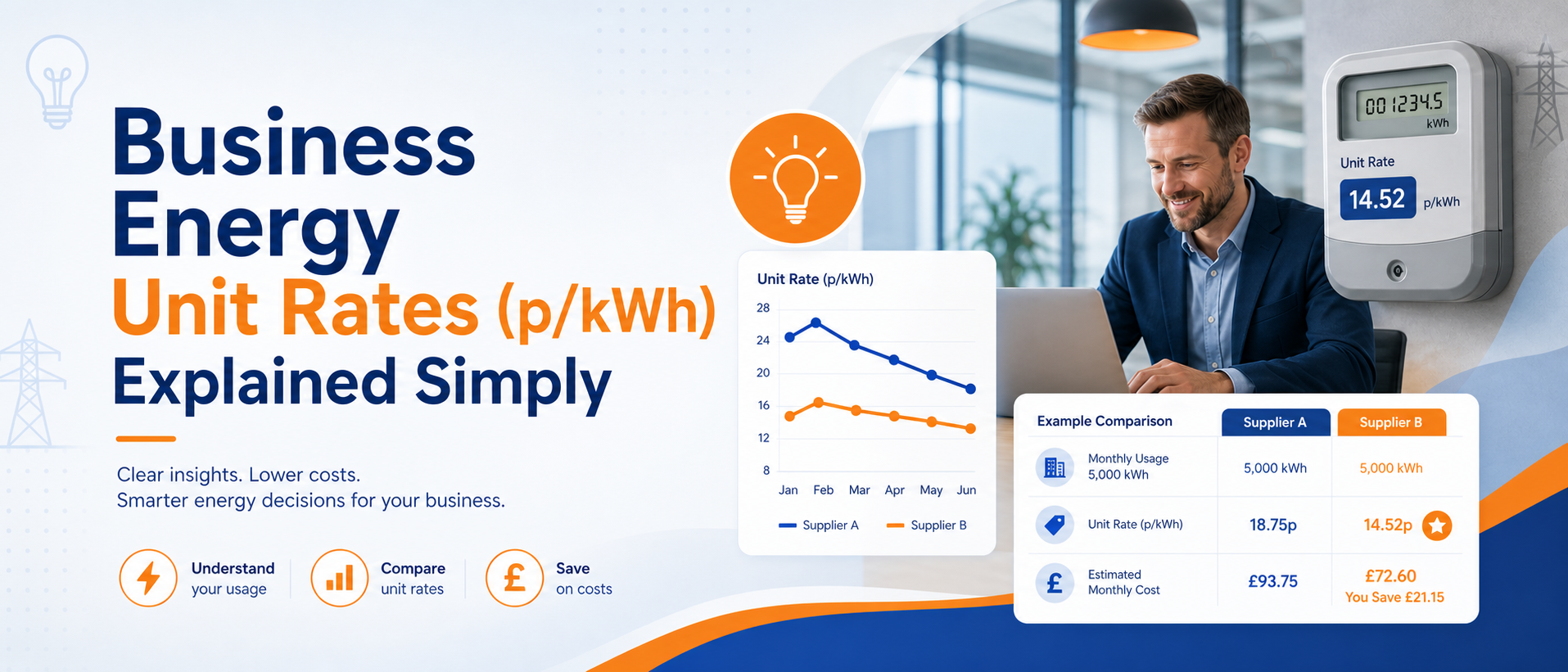

Your business energy unit rates is the price you pay for each unit of energy you use, shown in pence per kilowatt-hour (p/kWh). It is the largest variable on most business energy bills and the number that decides whether you are on a competitive deal or quietly overpaying. Get your gas and electricity unit rates right and everything else on the bill becomes easier to manage.
This guide explains what a unit rate is, what makes yours higher or lower than the business down the road, and how to bring it down. It sits alongside our complete guide to business energy and our breakdown of how to read your electricity bill.
What Is a Business Energy Unit Rate?
A unit rate is simply the cost of one unit of energy. One unit is one kilowatt-hour (kWh), which is the amount of energy a 1,000-watt appliance uses in an hour. Your supplier records how many units you use over the billing period, multiplies that figure by your unit rate, and that gives the energy portion of your bill.
You will have a separate unit rate for gas and for electricity, because they are supplied on separate contracts. Electricity almost always costs more per unit than gas, so a business that runs heavily on electricity will feel its unit rate more sharply.
How the Unit Rate Works on Your Bill
The calculation is straightforward: units used, multiplied by the unit rate. If your rate is fixed, that price per unit stays the same for the length of your contract, so your bill only rises and falls with how much energy you use. If your rate is variable, the price per unit itself can move with the wholesale market, which makes budgeting harder.
The unit rate is only half the picture. Sitting next to it is your standing charge, a fixed daily fee you pay whether you use any energy or not. A tempting unit rate can hide an expensive standing charge, so the two always have to be judged together.
What Affects Your Business Energy Unit Rate
Two businesses on the same street can be quoted very different unit rates. Here is what drives the difference:
- Wholesale energy prices. Suppliers buy energy on the wholesale market and pass the cost on. When wholesale prices rise, unit rates rise with them, which is why the timing of when you sign matters so much.
- Your contract type and length. Fixed contracts trade a slightly different rate for price certainty. Longer terms can lock in a rate for more years, which suits some businesses and not others.
- How much energy you use. Larger consumers often secure lower unit rates because suppliers compete harder for the volume.
- Your location. Regional network costs vary across the country, so the same usage is priced differently depending on where your premises sit.
- Your meter type. Standard, smart and half-hourly meters are all priced differently, and half-hourly meters can unlock more competitive rates for larger sites.
- Your business profile. Payment method, credit history and how reliably you have paid in the past can all feed into the rate a supplier offers.
- The day you ask. Because prices move constantly, a quote is a snapshot. Ask on a different day and the number can change.
Day Rate vs Night Rate
Some businesses are on a multi-rate meter, often called Economy 7 or a day and night meter. These charge a higher unit rate during the day and a lower one overnight. If your business does most of its energy-heavy work outside normal hours, a multi-rate setup can save money. If you run mainly nine to five, a single rate is usually simpler and cheaper. It is worth checking which type of meter you are on before assuming one is better.
How to Get a Lower Unit Rate
The biggest lever is securing the right contract at the right time. A few practical moves: compare the whole market rather than one or two suppliers, since business prices are bespoke and vary widely; time your renewal well, agreeing your next contract in the months before your current one ends so you lock tomorrow’s supply in at today’s price; judge the unit rate and standing charge together against your real usage; keep your meter readings accurate so any quote is based on true consumption; and use a broker to run the comparison for you, which is exactly the work we do across more than 20 suppliers.
Think your rate looks high?
Send us a recent bill and a UK-based broker will tell you, for free, whether your unit rate is competitive or quietly overpaying. No jargon, no pressure.
Request a free bill review →Why Two Businesses Get Different Rates
If a neighbour brags about a lower unit rate, it does not mean you are being cheated. Their usage, meter, contract length, credit profile and the day they signed all shape their rate. The only way to know whether yours is genuinely competitive is to compare your specific supply against the live market, which is quick to do and costs nothing.
Frequently Asked Questions
What is a good unit rate for business energy?
There is no single “good” figure, because rates move with the wholesale market and depend on your usage, location and meter. The useful question is whether your rate is competitive against the current market for a business like yours. Comparing your supply is the only reliable way to know.
Why is my electricity unit rate higher than my gas rate?
Electricity costs more to generate and deliver per unit than gas, so its unit rate is almost always higher. That is normal and applies to nearly every business.
Can I fix my business energy unit rate?
Yes. A fixed-rate contract locks your unit rate for the whole term, so the price per unit will not change even if the market rises. Your bill still moves with how much you use, but the rate is protected.
Do unit rates include VAT and the Climate Change Levy?
The unit rate itself is the price per kWh before those are added. VAT (usually 20%, or 5% if you qualify) and the Climate Change Levy are applied on top, so your final bill is a little higher than unit rate times usage alone.
How often do business energy unit rates change?
Wholesale prices change daily, so the rates suppliers offer to new customers move constantly. Once you are on a fixed contract, though, your own rate is locked for the term regardless of what the market does.
See what you could be paying instead
Now you know what drives your unit rate, put it to the test. Find out in under two minutes whether a better deal is waiting.
Try the Business Energy Calculator →