
Business Energy Guides
What Is a Standing Charge on Your Business Energy Bill?
The daily fee you pay before you've used a single unit of energy: what it covers, why it varies so much, and whether you can ever get rid of it.
By the Sonix Energy team · Kingston upon Hull · Updated 2026 · 6 min read
A standing charge is a fixed daily fee on your business energy bill that you pay simply to be connected to the gas or electricity network, every single day, whether your premises use any energy or not. It's charged in pence per day, listed separately from your unit rate, and it applies to your gas and electricity as two separate charges.
It's one of the most misunderstood lines on a bill, and one of the most overlooked when businesses compare deals. Understand it properly and you'll never again be fooled by a headline unit rate that hides an expensive standing charge behind it. This guide sits alongside our complete guide to business energy and our breakdown of how to read your electricity bill.
Why do I pay a standing charge?
The standing charge covers the cost of keeping you supplied, regardless of how much you actually consume. In practice, it pays towards:
- Maintaining the network: the pipes, cables, substations and infrastructure that deliver energy to your door.
- Your meter: providing it, maintaining it and taking readings.
- Keeping the connection live: the cost of being ready to supply you at any moment.
- Distribution and other pass-through costs: charges from the network operators that suppliers recover through this fee.
Think of it as a line-rental for energy: a base cost for having the service available, before you've used any of it.
How much is a business energy standing charge?
There's no single figure, because it depends on several factors specific to your premises. What drives it up or down:
| Factor | Effect on your standing charge |
|---|---|
| Your region | Network costs differ across the country, so the same business pays different amounts in different areas. |
| Meter type | Larger premises and half-hourly meters usually carry higher standing charges than a small single-rate meter. |
| Your supplier & contract | Each supplier prices the charge differently, and it's fixed for the length of your contract. |
| Gas vs electricity | You pay a separate standing charge on each: two contracts, two daily fees. |
Because it's set per premises and per contract, the only reliable way to know yours is to read it off your bill; it'll be shown clearly as a pence-per-day figure.
The trap: unit rate vs standing charge
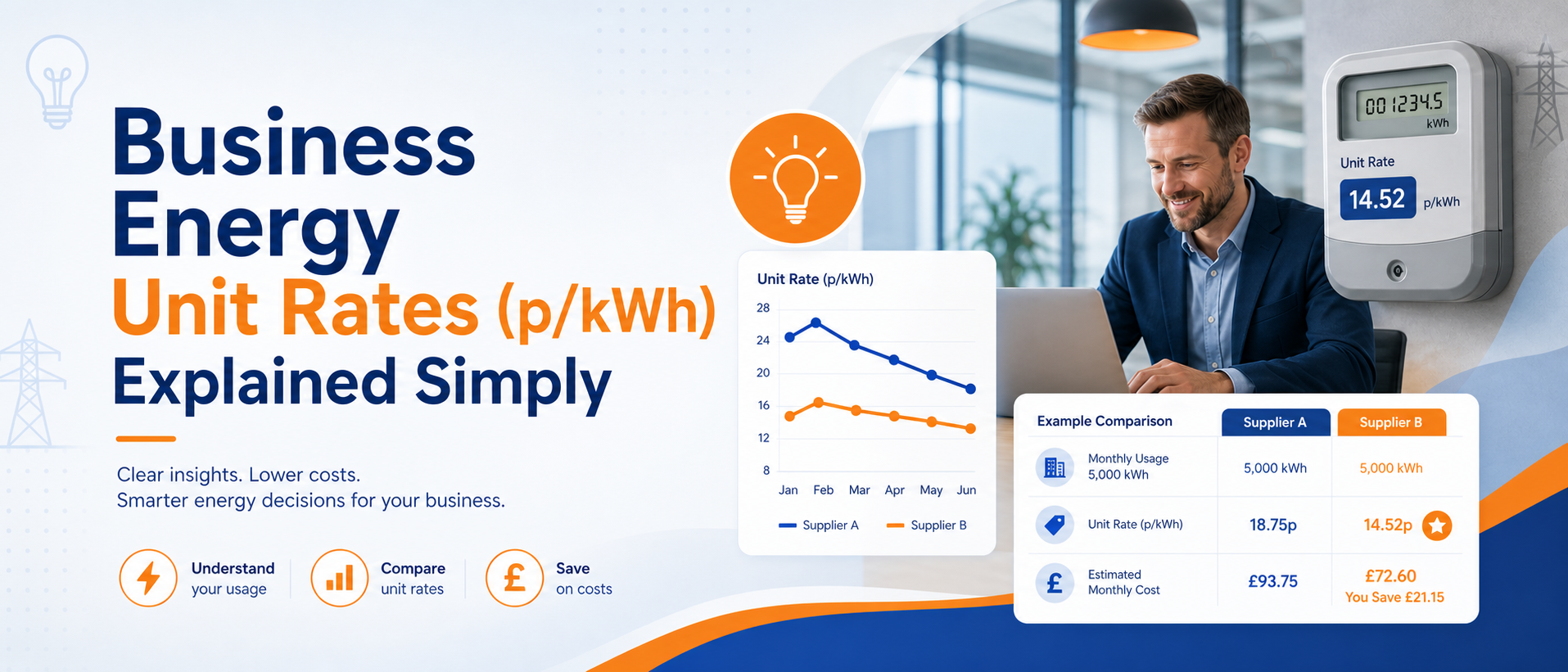
Here's where businesses lose money. Suppliers know owners fixate on the unit rate, so a deal can advertise a tempting low p/kWh while quietly loading a high standing charge on top. Over a year, that daily fee adds up, and a "cheaper" tariff can end up costing you more than the one you rejected.
Can I avoid or reduce the standing charge?
While your meter is connected, you can't escape a standing charge entirely, but you can manage it:
- Compare it as part of the whole deal. Shopping the market lets you find contracts where the combination of unit rate and standing charge suits your usage pattern.
- Consider a no-standing-charge tariff, carefully. A few tariffs drop the daily fee but charge a higher unit rate to compensate. These only make sense for very low-usage or seasonal premises; for most businesses the higher unit rate wipes out the saving.
- Deal with empty premises. You still pay the standing charge on a vacant unit that's connected. If a site will sit unused long-term, disconnecting the meter is an option, though that carries its own cost and process, so it's worth advice first.
- Align multi-site contracts. Consolidating sites can strengthen your position when negotiating the whole package, standing charges included.
Is your standing charge quietly inflating your bill?
Send us a recent bill and a UK-based broker will compare your full cost (unit rate and standing charge) against the wider market, free of charge.
Request a free bill review →Frequently asked questions
Do I pay a standing charge if my business uses no energy?
Yes. The standing charge is a fixed daily fee for being connected to the network, so it applies every day regardless of usage, including on premises that are empty but still connected.
Do I pay a standing charge on both gas and electricity?
Yes. Business gas and business electricity are supplied on separate contracts, and each has its own standing charge, so you'll see two daily fees across your two bills.
Why is my standing charge higher than another business's?
Standing charges vary by region, meter type, supplier and contract. A larger premises, a half-hourly meter or a higher-cost network area will all push the figure up compared with a small single-rate supply elsewhere.
Are no-standing-charge business tariffs worth it?
Only for very low-usage or seasonal premises. They remove the daily fee but charge a higher unit rate to make up for it, so for most businesses with steady usage the higher unit rate costs more overall.
Can I negotiate my standing charge?
You don't negotiate it in isolation, but by comparing the whole market you can find a contract where the combined unit rate and standing charge best fits your usage. That's the practical way to bring the total down.
Compare the full cost in two minutes
Unit rate, standing charge, the lot, see what a competitive business energy deal really looks like for your premises.
Try the Business Energy Calculator →